
Tires, Tracks, and Undercarriage
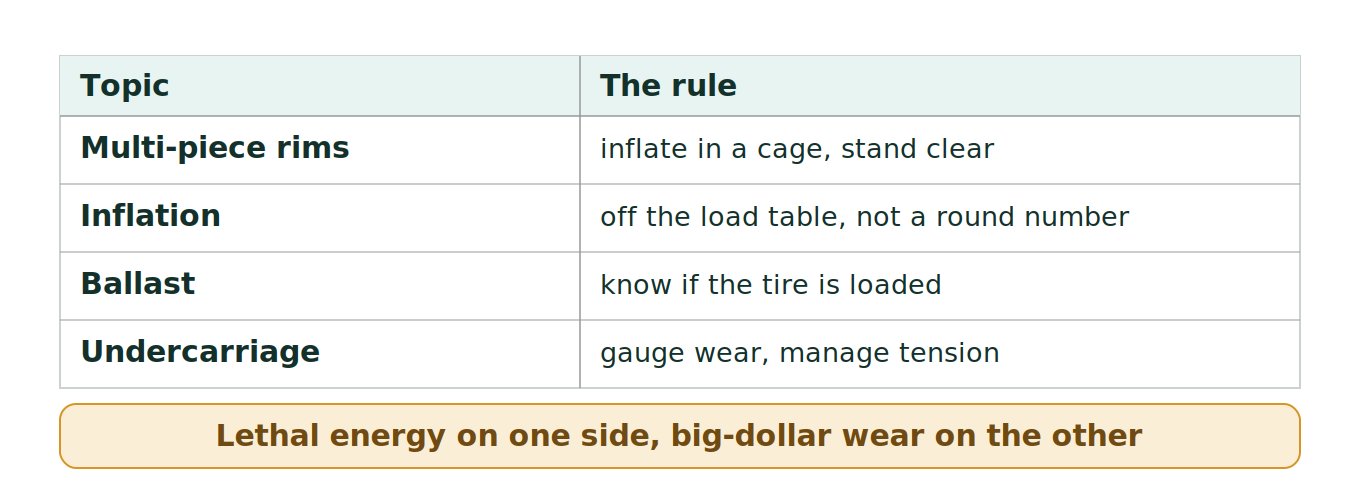
The most expensive wear items on the machine and the ones that put people in the hospital. Two things stay front of mind: the energy in an inflated ag tire will kill you, and inflation pressure and undercarriage wear are money decisions read off tables and gauges, not judged by eye.
The energy is lethal
Multi-piece and split rims separate explosively when misassembled, corroded, or inflated with a mismatched ring. Inflate in a cage or with a restraint, use a clip-on chuck with an inline gauge, and stand out of the trajectory — off to the side, never over the assembly. A large radial holds enough stored energy to throw a rim through a person, so treat every inflation as loaded. Seat beads at rated pressure only; chasing a stubborn bead with more air is how they let go. And know when a tire is ballasted — calcium chloride is heavy and eats rims from the inside, while the newer fills (washer fluid, beet/polymer solutions) change weight and handling.
Inflation is a load decision
Pressure comes off the load-and-inflation table for the axle weight and travel speed, not a round number everyone reuses. Under-inflation flexes and overheats the sidewall; over-inflation shrinks the footprint, drops traction, and packs the ground — and compaction is yield the customer never sees again. IF/VF tires carry the same load at lower pressure for a larger footprint and less compaction, which is worth raising with a customer setting up a new machine. Anyone running one pressure year-round across every load is burning tire life and compacting fields.
Undercarriage is measured
Track undercarriage — bushings, links, rollers, idlers, sprockets, and the belt or chain — is a major cost managed by measurement, not by waiting for failure. Gauge the wear percentages, plan replacement at the economic point, and hold tension and alignment: over-tension and misalignment burn an undercarriage out early. Belt tracks go from misalignment, low pressure, and bad storage; steel tracks from tension and lube neglect. Catching wear at the right percentage instead of running to destruction is one of the larger dollars a service department manages for a customer.
Where it goes wrong
- Inflating a multi-piece rim outside a cage, or standing in the trajectory.
- Seating a bead past rated pressure.
- Setting one pressure for every load instead of pulling the table.
- Running a track undercarriage to failure instead of gauging wear.
- Ignoring tension and alignment and eating an undercarriage early.
Related
Shop safety and stored energy · Tracks vs. tires (sales) · Preventive maintenance · Compaction economics.